














 Time:Oct 20, 2025
 Share:


In 1932, German scientists first isolated equol from the urine of pregnant mares, marking the beginning of research into the metabolism of soy isoflavones. After decades of investigation, in 1984, a Japanese research team identified equol as the final metabolic product of soy isoflavones in human urine, thereby establishing its significance in human nutritional metabolism.
Modern molecular biology research has revealed that naturally occurring equol exists in two enantiomeric forms: (S)-equol and (R)-Equol. A pivotal breakthrough came in 2005 when Setchell’s team discovered that the naturally produced enantiomer in human metabolism is S-equol, which shares a striking structural similarity with endogenous estrogen, 17β-estradiol. X-ray crystallography analysis demonstrated that the hydroxyl spatial arrangement of S-equol mirrors that of the C3 hydroxyl group of estradiol, a structural homology that underpins its unique biological properties.
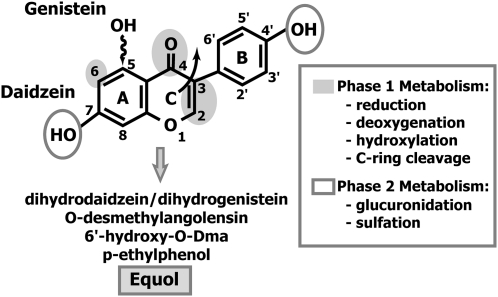
Large-scale population studies indicate that only 20-35% of adults harbor the gut microbiota necessary to convert daidzein into S-equol[1]. This “equol producer” phenotype is closely associated with specific bacterial species, such as Slackia isoflavoniconvertens. Genome-wide association studies (GWAS) have identified genetic polymorphisms in β-glucosidase genes that contribute to stable equol conversion capacity in certain individuals.
Estrogen Receptor Targeting Mechanisms: The Mode of Action of S-equol
Receptor Selectivity and Mechanistic Insights
The affinity of S-equol for estrogen receptor β (ERβ) (Ki=0.73nM) is significantly higher than that of estrogen receptor α (ERα) (Ki=6.41nM), and this approximately 9-fold selective difference stems from the complementarity of its molecular conformation with the binding domains of the ER ligand [2]. Computerized molecular docking simulations revealed differences in the binding sites of the active pockets of ERα and ERβ, which may account for the large difference in binding of S-equol to two different estrogen receptors [3].
Complex Biological Effects of S-equol
In a low estrogenic environment, S-equol exerts estrogen-like effects by activating the ERβ-mediated transcriptional pathway [4]; when S-equol is at a high concentration, instead, ERα is fully activated, and in line with estradiol, ERβ-only expressing cells show less elevated expression levels of the ERβ downstream gene OTUB2 with S-equol, suggesting that S-Equol Although ERβ-biased, its action is still dependent on ERα transduction [5].
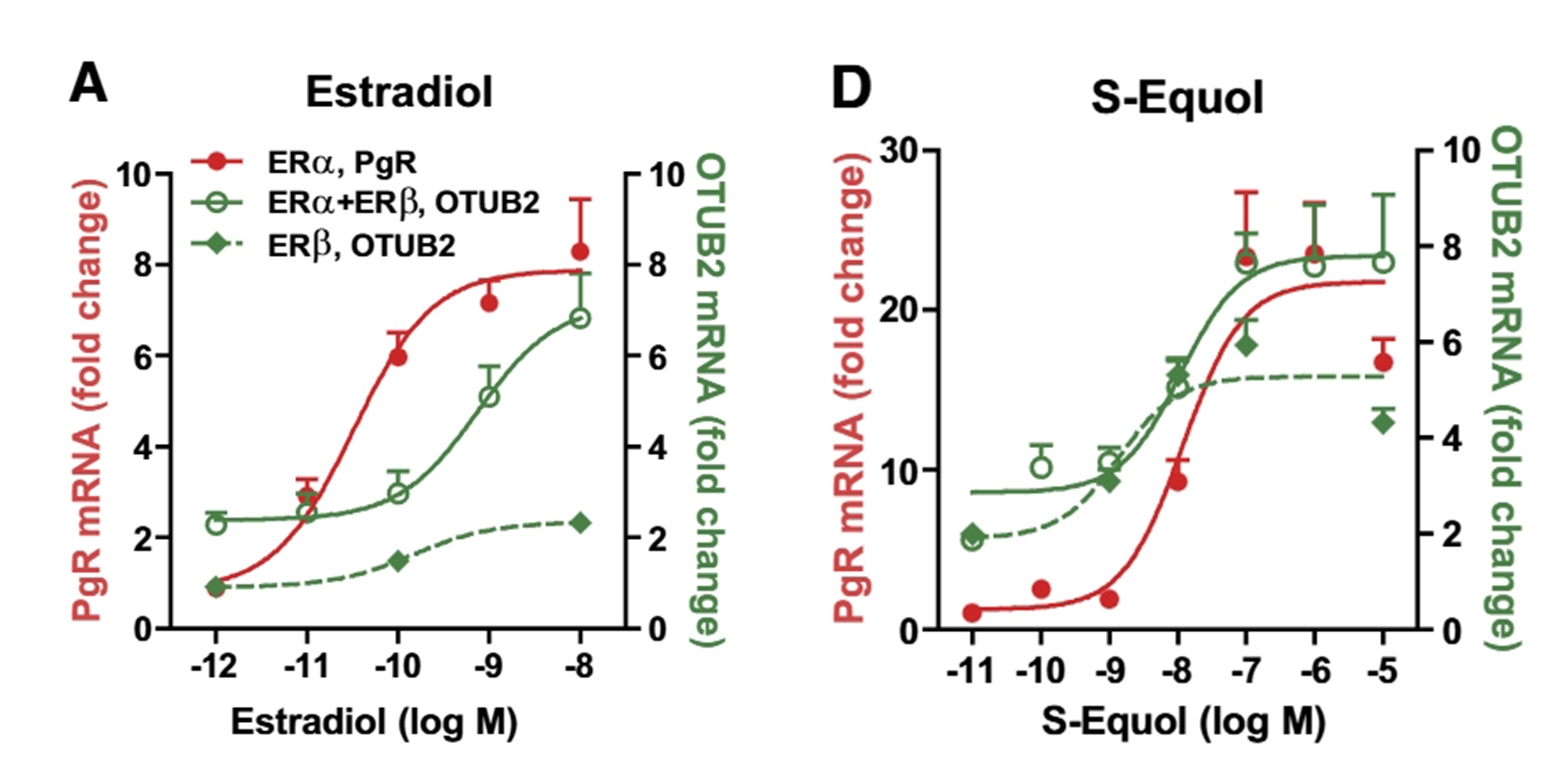
Figure: ERα-driven expression of progesterone receptor (PgR) genes in red; ERβ-driven expression of OTUB2 genes in green.
A Paradigm Shift in Menopausal Health Management
Menopausal syndrome is a disorder in women who exhibit insomnia, hot flashes, agitation and depression due to estrogen deficiency in the body [6].
Although conventional hormone replacement therapy (HRT) is effective in relieving symptoms such as hot flashes and night sweats, its long-term use can increase the risk of breast cancer by 26% (data from the WHI study) and elevate the rate of cardiovascular events by 29% [7]. Therefore, finding safer and effective treatments has become one of the urgent problems.
In the European and American dietary supplement markets, the main menopausal dietary supplement in use today is soy isoflavones, which exert estrogenic activity by selectively binding to ERβ without estrogenic side effects (side effects are mainly due to activation of the α-estrogen receptor).
(S)-equol, its metabolite, also has estrogenic activity. In vivo experiments have shown that less than 20% of soy isoflavones, such as soy glucosides and genistein, are biologically active in the free form, but up to 50% of soy isoflavones are (S)-equol and are not biotransformed.
Meanwhile, the parallel artificial membrane permeation technique (PAMPA) showed that (S)-equol has higher gastrointestinal and blood-brain barrier (BBB) permeability than soy glucosides or genistein [8].
For estrogenic compounds, safety is paramount. Comparative analysis of the S- and R-enantiomers of equol indicates that S-equol is superior in safety, ERβ affinity, bone health promotion, and mitochondrial energy enhancement, making it a promising candidate for menopausal supplementation.
Property | (S)-equol | (R)-equol or (R/S)-equol |
|---|---|---|
Human Safety Studies | 160 mg/day (14 days) | — |
ERβ Affinity [10] | 0.7 nM | 15.4 nM |
Osteoblast Differentiation [11] | 15-37% increase | Baseline |
Mitochondrial Function [12] | (S)-equol is superior to (R/S)-equol in mitochondrial respiration and aerobic glycolysis | |
Note: The lower the value in the ERβ affinity column, the higher the affinity.
Multifaceted Health Benefits of S-equol
1. Bone Health
S-equol promotes osteogenic differentiation and inhibits RANKL-mediated osteoclastogenesis through the PI3K/Akt pathway [14]. Clinical data showed a slower rate of BMD reduction in estradiol-producing women compared to non-estradiol producers, an association between estradiol-producing status and a reduction in markers of bone resorption (e.g., urinary deoxypyridinoline), and that one year of continuous supplementation with 10 mg/day of S-equol significantly inhibited bone resorption, with an augmentation of urinary deoxypyridinoline to 23.94% from 2.87% in the placebo group [15].Women with a high baseline risk of bone resorption or fracture were more likely to have reduced levels of urinary N - terminal peptide (associated with bone resorption) after estramustol intervention [16].
2. Vasomotor Symptoms
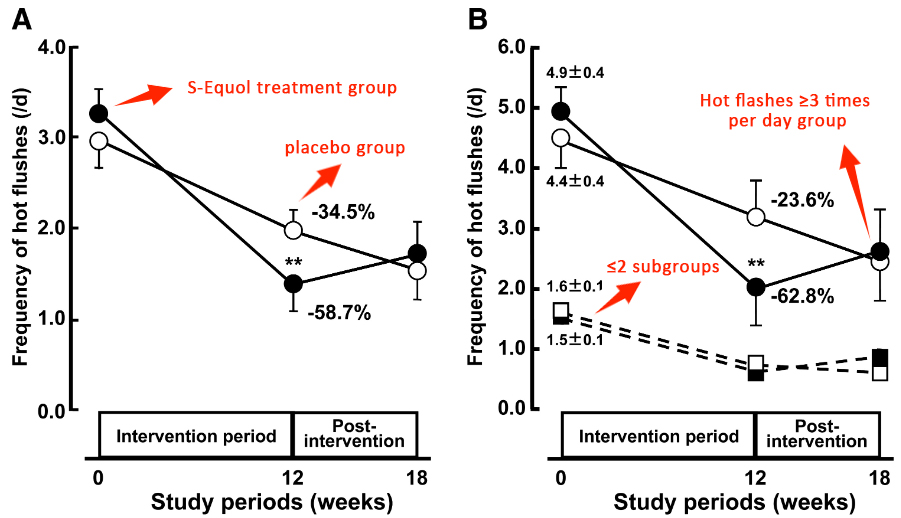
A randomized controlled trial (RCT) involving 126 women demonstrated that S-Equol reduced the frequency of moderate-to-severe hot flashes from 4.9 episodes per day to 2.0 episodes (p < 0.001), a 62.8% reduction compared to baseline. Notably, S-Equol was most effective in women experiencing more than two hot flashes daily. The proposed mechanism involves neuronal regulation in the hypothalamic thermoregulatory center.
3. Cognitive Protection
Animal experiments showed that S-Equol treatment significantly reduced cocaine addiction behavior in rats with HIV-1-related neurocognitive impairment, and that S-equol, but not soy isoflavones, was negatively correlated with arterial stiffness and white matter lesions, which are vascular lesions that lead to cognitive impairment and dementia [8], and that this neuroprotective effect may be related to ERβ-mediated activation of the PI3K/Akt pathway [18].
Safety Evaluation and Clinical Applications
Toxicological study data
S-equol has published a full set of toxicological safety data. Acute toxicity tests showed an LD50 >5000 mg/kg (rat), and no organ pathologic changes were observed in subchronic toxicity studies (90 days) at NOAEL doses. Mutagenicity tests (Ames test, micronucleus test) were negative and reproductive toxicity studies showed no significant effects on ovarian reserve function. In comparison, R-equol is not supported by safety data[19].
Clinical Adverse Reaction Profile
Two randomized, double-blind, placebo-controlled clinical trials were conducted in healthy volunteers: a single-dose (10-320 mg) study with 61 participants and a 14-day multiple-dose (10-160 mg, BID) study) on 40 participants, all of whom tolerated S-estranol well; there were no major drug-related adverse events, and the Adverse reactions were mainly mild gastrointestinal discomfort [20].
Future Perspectives
Precision Nutritional Strategies
Personalized intervention based on intestinal flora detection: identify Equol producer phenotypes through macro-genome sequencing, together with probiotic (e.g. Lactobacillus spp., Bifidobacterium spp.) colonization, increase the proportion of S-Equol-producing flora, so as to make the conversion efficiency improved.
Expanded application areas
Recent studies suggest that S-Equol shows potential in the management of metabolic syndrome (up-regulation of IRS-1 to improve insulin sensitivity and increase of Glut2 to stimulate insulin secretion)[21], and protection against skin photo-aging (1.5-fold increase in the expression of TIMP-1, no change in R-Equol) [22].
Conclusion
From a gut microbial metabolite to a core component of menopausal health management, the translational application of S-Equol exemplifies the exemplary value of translational medicine. With the in-depth analysis of the mechanism of action and the continuous optimization of combination therapies, this natural molecule is redefining the paradigm of menopausal health management. In the future, precise intervention strategies based on systems biology will drive menopause medicine into a new era of “targeted regulation and multi-dimensional synergy”.
For brands exploring multi-ingredient menopause formulas, shatavari (standardized as SheVari4™) offers a complementary adaptogenic and phytoestrogenic mechanism that pairs well with S-equol — covering the HPA axis and cortisol regulation dimensions that S-equol alone does not address. Read our clinical review of shatavari benefits for women.
This article is for informational purposes only and does not constitute medical advice. Please consult a qualified healthcare provider before starting any new supplement or treatment regimen.
References:
[1] Setchell K D, Clerici C. The Journal of nutrition, 2010, 140(7): 1355s-62s.
[2] Setchell K D, Clerici C, Lephart E D, et al.American Journal of Clinical Nutrition, 2005, 81(5): 1072-1079.
[3] Kato K, Fujii K, Nakayoshi T, et al. Journal of Physics: Conference Series, 2018, 1136: 012021.
[4] Nishimura Y, Mabuchi K, Takano A, et al. Frontiers in endocrinology, 2017, 8: 281.
[5] Jiang Y, Gong P, Madak‐Erdogan Z, et al. FASEB Journal, 2013, 27(11): 4406-4418.
[6] Manson J E, Hsia J, Johnson K C, et al. New England Journal of Medicine, 2003, 349(6): 523-534.
[7] Chen L R, Chen K H. International journal of molecular sciences, 2021, 22(6).
[8] Sekikawa A, Wharton W, Butts B, et al. International journal of molecular sciences, 2022, 23(19).
[9] Jackson R L, Greiwe J S, Desai P B, et al. 2011, 18(2): 185-93.
[10] Lephart E D. International journal of molecular sciences, 2017, 18(6).
[11] Tanaka M, Fujii S, Inoue H, et al.The Journal of nutrition, 2022, 152(8): 1831-42.
[12] Yao J, Zhao L, Mao Z, et al. Brain research, 2013, 1514: 128-41.
[13] Muthyala R S, Ju Y H, Sheng S, et al.Bioorganic & Medicinal Chemistry, 2004, 12(6): 1559-1567.
[14] Xu Z, Xu J, Li S, et al. Frontiers in Nutrition, 2022, 9: 986192.
[15] Tousen Y, Ezaki J, Fujii Y, et al. Menopause, 2011, 18(5): 563-574.
[16] Yoshikata R, Myint K Z Y, Ohta H.The Journal of Alternative and Complementary Medicine, 2018, 24(7): 701-708.
[17] Aso T, Uchiyama S, Matsumura Y, et al. Journal of Women’s Health, 2012, 21(1): 92-100.
[18] Zhang T, Liang X, Shi L, et al. PLoS ONE, 2013, 8(11): e79075.
[19] AnandaKumar S R, Handral M, Seekallu S. Toxicology Reports, 2024, 13: 101823.
[20] Jackson R L, Greiwe J S, Desai P B, Menopause (New York, N.Y.), 2011, 18(2): 185-193.
[21] Kai L, Ka Ch, Rui Zh. Progress in Modern Biomedicine,2013,13(7):1210-1213.
[22] Lephart E D. International journal of molecular sciences, 2017, 18(6): 1193.






 +1(425)866-9043
 sales@bonerge.com